Deliciously Detailed: Unlocking the Potential of Eat It Up Color
If you have spent any time scrolling through food blogs or perusing the aisles of a specialty grocery store, you know that visual appetite is just as important as the actual flavor. We eat with our eyes first. For designers and content creators working in the culinary space, capturing that textural, mouth-watering appeal has historically required complex illustration or heavy Photoshop work. Enter Eat It Up Color, a bundle of illustrative color fonts that brings high-definition snack textures directly into your typography workflow. This isn't just a font; it is a design asset that functions as a miniature illustration for every letter you type.
The Anatomy of a Treat: Visual Characteristics and Style
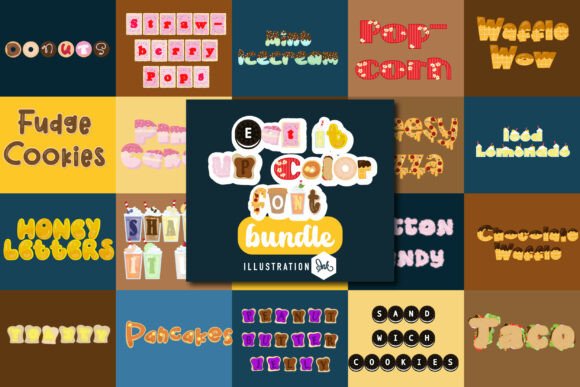
At its core, Eat It Up Color is a collection of premium font files that utilize OpenType-SVG technology. To the uninitiated, this means the font files contain vector shapes with high-resolution bitmap images embedded within them. When you type a letter, you aren't just seeing a flat silhouette of a "W"; you are seeing a "W" filled with the actual texture of a savory waffle, the crystalline sheen of sprinkles, or the gooey stretch of melted cheese.
The bundle includes a variety of "flavors," such as "Waffle Wow," "Mint Ice Cream," and "Cheesy Pizza." Each typeface possesses a distinct personality. The "Mint Ice Cream" style, for example, offers a cool, pastel aesthetic with realistic sprinkle textures that feel almost 3D. In contrast, the "Cheesy Pizza" style is warm, rustic, and dripping with savory appeal. Because these are color fonts, the hues are baked right in, preserving the exact color palette intended by the designer. This creates a creative font experience that is ready to use immediately, requiring no additional layering or masking to achieve that artisanal look.
Strategic Applications: Where Texture Meets Function
Understanding where to deploy a heavy, textured display font like this is crucial for maintaining visual hierarchy. You would not set a paragraph of body copy in "Taco" letters; the result would be illegible and exhausting to read. Instead, Eat It Up Color is designed for impact. It shines brightest in headlines, hero text, and logos where immediate emotional connection is required.
Branding and Packaging Design
For independent food trucks, artisanal bakeries, or pop-up restaurants, brand identity is everything. Using Eat It Up Color for a logo design or menu header can instantly communicate the vibe of the establishment. A bakery using the sprinkle texture signals fun and whimsy, perfect for a shop specializing in cupcakes or donuts. A food truck using the "Taco" texture immediately sets expectations for casual, flavorful street food. In packaging design, these fonts can be used on stickers, paper cups, or wrapping paper to reinforce the product's artisanal quality without needing custom illustration for every surface.
Digital Presence and Social Media
In the fast-scrolling environment of social media, grabbing attention is the primary metric of success. Social media graphics benefit immensely from the high-energy nature of this bundle. If you are a food vlogger creating a thumbnail for a "Mukbang" video or a recipe reel, the Eat It Up Color headers provide an instant visual hook. It translates exceptionally well to web design headers for food blogs, where it can set a playful tone for the editorial design of the site. The textures are sharp enough to hold up on high-resolution Retina screens, ensuring your web design looks crisp.
Publishing and Editorial Work
Publishers of children’s cooking books or lifestyle magazines often struggle to find typography that feels "lively" rather than corporate. This bundle acts as a bridge between text and image. It is particularly effective for chapter titles in cookbooks or pull-quotes in food magazines. Unlike standard serif font or sans serif font options, which rely on structural elegance, Eat It Up relies on material association. It brings a tactile element to the page that standard modern typography cannot achieve.
Design Mechanics: Pairing, Hierarchy, and Readability
Integrating a specialized display font into a broader design system requires a thoughtful approach to font pairing. Because Eat It Up is loud, detailed, and textured, it demands a quiet partner. Pairing it with a neutral geometric sans serif font for body text is usually the safest route. The clean lines of a sans-serif allow the intricate details of the "Waffle" or "Ice Cream" textures to breathe without visual competition.
Alternatively, for a more organic or rustic brand identity, you might consider pairing it with a clean, legible script font or a handwritten font, provided the script is not too ornate. The goal is to create contrast in complexity. If the header is complex (texture), the body must be simple (flat color).
Readability is a key consideration. While the letters are distinct, the textures can sometimes obscure the edges of the characters if the font size is too small. As a rule of thumb, this creative font should be used at larger point sizes—typically 30pt and above for print, and larger for digital screens. Testing the font on different backgrounds is also vital. A "Cheesy Pizza" letter placed on a red background might lose definition, whereas placing it on a neutral white or kraft paper background allows the yellow and red tones to pop, enhancing brand recognition.
Practical Evaluation: Licensing and File Management
Before incorporating Eat It Up Color into a client project, it is essential to review the specifics of the asset bundle. As a commercial font, it comes with licensing that dictates how it can be used. Most bundles of this nature allow for desktop use (logos, print) and often include webfont formats for web design, but always verify the license terms regarding the number of users or the volume of impressions allowed.
From a technical standpoint, remember that color fonts are larger in file size than standard vector fonts. If you are using this for web design, be mindful of page load speeds. It is often best to use this font exclusively for the main headline (H1) or a logo graphic, rather than loading it for every heading on a long page. Converting the text to outlines (vector paths) in Adobe Illustrator or rasterizing it in Photoshop is a common workaround for print design to ensure the textures render correctly on any press, though this means the text is no longer editable.
Ultimately, Eat It Up Color is more than just a novelty; it is a specialized tool for design assets that require a human, homemade touch. It solves the problem of how to make digital text feel tangible and appetizing. Whether you are crafting a logo for a new bakery, designing a flyer for a local food festival, or creating headers for a culinary blog, this bundle offers a distinct personality that flat typefaces simply cannot match. By pairing it wisely and using it strategically for high-impact areas, you can ensure your designs satisfy the creative cravings of your audience.